
The Misalignment of “Emergency” & “Crisis” Between Mental Health and Cyber Incident Response
Read more articles
Divergent Definitions, Divergent Responses
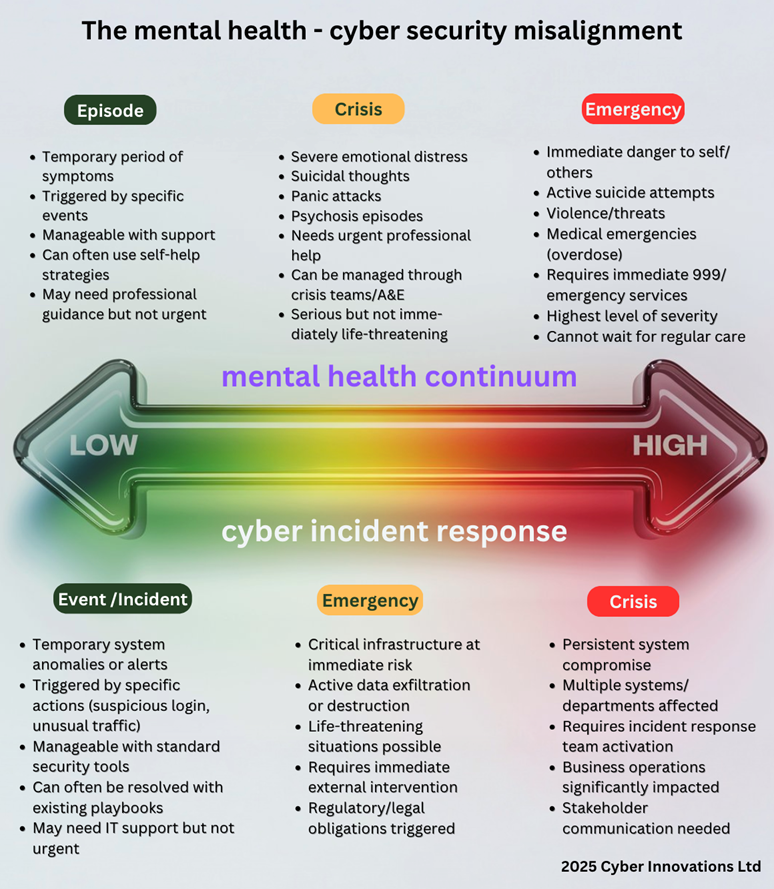
The St. John Ambulance Mental Health Reference Guide defines a mental health emergency as an immediate risk to life (e.g., suicide attempts, violence), requiring urgent intervention. A crisis, meanwhile, involves severe distress (e.g., panic attacks, psychosis) that demands professional support but does not necessarily require emergency services. This distinction ensures responders prioritise actions: emergencies trigger 999 calls, while crises require de-escalation and referrals.
In cybersecurity, following risk assessment and disaster recovery frameworks, “emergency” and “crisis” suggest the opposite prioritisation and severity. For example, a single infected workstation might be classified as an emergency, while a crisis would involve a ransomware attack encrypting company-wide systems.
Without standardised definitions, organisations risk misallocating resources—delaying containment or overreacting to non-critical events.
Why This Misalignment Matters
1. Resource Allocation:
- Mental health frameworks prioritise urgency: emergencies trigger ambulances; crises mobilise counsellors.
- In cybersecurity, mislabelling incidents can lead to inconsistent responses. Declaring a “crisis” too late might allow a manageable threat to escalate into a full-blown emergency (e.g., undetected ransomware spreading). Conversely, overusing “emergency” for minor incidents breeds complacency.
2. Communication Gaps:
- Mental health first aiders are trained to distinguish between stages (e.g., “reacting” vs. “ill”).
- Cybersecurity teams often lack analogous frameworks, resulting in fragmented communication between technical staff, executives, and legal teams.
3. Human Cost:
- Cyber incidents increasingly impact mental health. Employees facing breach-related stress may enter a mental health crisis, yet organisations rarely integrate psychological support into cyber response plans.
Bridging the Divide: The Cyber First Aid Approach
In Cyber First Aid, the distinction between emergency and crisis boils down to one key question:
“Is there a playbook to handle the cyber incident?”
- If the answer is “Yes”, then we are dealing with an emergency—it’s an expected scenario with a predefined response.
- If the answer is “No”, then we have a crisis—the situation is novel, unanticipated, and requires strategic decision-making rather than routine action.
This redefinition aligns cyber incident response with mental health models, ensuring structured, proportional responses that account for both technical and psychological impacts.